Wednesday, March 5, 2014
Sun Plant
A fast growing, succulent annual, reaching a maximum size of 1 x 2 feet, with reddish stems and bright green, narrow succulent foliage.
The fleshy leaves can reach up to 1 inch in length.
The flowers, up to 2 inches across, borne all summer into early autumn are brilliant white, yellow, red or purple with showy yellow stamens.
The flowers close during the night.
It is highly recommended as an annual bedding plant for the fronts of borders on very hot dry sites as well as patio planters that are not watered on a regular basis.
It can also be grown in hanging baskets and between stones.
This plant is the epitome of xeroscaping made beautiful!
Thrives in full sun on well drained soil. Plant outside during spring after threat of frost has passed.
The Sun Plant is native to southern Brazil, Uruguay and northern Argentina.


* photos taken on June 12 2013 in Columbia, MD


Tuesday, March 4, 2014
Situationism


During research for my dissertation I came across the Situationists, (an Avant Garde movement).
Some of their ideas particularly interested me, that of drifting and psychogeography.
Drifting transalated from the French verb Deriver (there should an accent above the first e but Im not sure how to type one in) refers to wandering the city defining the journey by emotions (i.e. attractions to structures and places) rather than simply travelling to predetermined destinations. It reminded me of that often misguided slogan, that getting there is half the fun.
Psychogeography is the collation and mapping of the drifts. The images show some examples of psychogeographic maps, I plan to draw one or some up for my dissertation, more then to follow.................
Warming Trends Made in the USA Manufactured On Site

3 Custom Fire PIt Burner Systems
From cutting custom plates, to assembling custom fire pit frames, to custom burning systems, we make everything here on site exactly to your dimensional requirements. You can choose from our three standard systems, OR, we can custom fit any fire pits to your architectural needs. We work with homeowners, commercial businesses, architects, builders, contractors and landscape designers. We pride ourselves on the fact that whatever your design requirements are, we can build whatever you need based on your specs.

Cutting aluminum pans to size.
Warming Trends, LLC, is a family owned and operated business who has been in operation for over eighteen years. We specialize is making and manufacturing high–end, quality fire pits and fire systems for your home or commercial outdoor entertainment space. In addition to our Crossfire Burner System, Warming Trends also manufactures and distributes custom fire pits, outdoor fireplaces, pre-built patio hearths, tiki torches, and more.

Grinding screws off of the control module.
President, Ray Stone runs the operation from the top. Mike Windemuller handles the General Manager duties and brings over 20 years sales and operations experience to the table. Steven Koepp guides the production process at the headquarters onsite . Tre Rudig, of YOUDIGRUDIG MEDIA, builds and maintains all website operations, including all online marketing and AdWord campaigns. We take pride in our craft and make sure that all of our systems are top of the line and back all of our products with a full factory warranty.

Custom fire pit frame ready for finishing.

We here at Warming Trends have developed the newest state of the art outdoor patio flame system. Our Crossfire Burner was developed with a precise air to gas ratio that produces a taller, brighter flame, BUT, it uses only HALF the fuel of conventional fire rings. We developed this one-of-a-kind system so you reap the benefit of saving money and fuel consumption. Now THAT’s thinking GREEN.

Crossfire Burners
Let Warming Trends help you heat up your outdoor entertaining experience by “Bringing an warm glow to your patio!” Call us today. 1-877-556-5255.

Heat Shrinking the Spark Wires

Our Welding Machine

Our Testing Table - Nothing leaves the grounds before we test it for quality assurance.

Aluminum spun pans.
Pierson Park Ornamental Community Garden
 |
| Hen & Chicks Sempervivium |
 |
| Purpletop Vervain Verbena bonariensis |


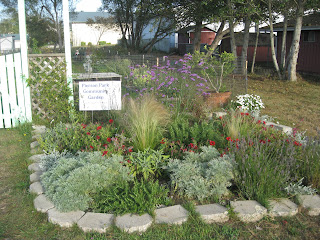
- Wormwood Artemesia Powis Castle
- Prostrate Rosemary Rosmarinus officinalis Prostratus
- Rosemary Rosmarinus officinalis
- English Lavender Lavandula angustifolia
- Garden Sage Salvia officinalis
- Petunia
- Jerusalem Sage Phlomis fruticosa
- Licorice Plant Helichrysum petiolare
- Mexican Feather Grass Nassella tenuissima
- Purpletop Vervain Verbena bonariensis
- Hen & Chicks Sempervivium
- White Climbing Rose Rosa
- Sweet Pea Lathyrus odoratus
- Autumn Sage Salvia greggii
- Blue Fescue Festuca glauca
- Variegated New Zealand Flax Phormium tenax
- Nasturtium Tropaeolum majus
- Rose Rosa
- Low-growing Lambs Ears Stachys
- Canna Canna
Monday, March 3, 2014
5 Unique and Strange Holiday Christmas Traditions

So in the vein of the holidays, I thought Id do a fun blog posting today and did some homework on unique and strange holiday Christmas traditions from around the world. After researching and cross-referencing different websites, it was funny to see that indeed, there are several different sources confirming these wacky holiday traditions. From pooping logs, to Japanese KFC Santa, to Krampus, the evil anit-santa.....so for the sake of fun and for no other reason than "tis the season," let us be enlightened, or well, educated...on some strange worldwide holiday traditions.
Krampus - The Evil Anti-Santa - Austria

This evil looking character looks like a satanic representation of what has been depicted over time as, well, what satan might look like. In Austria, Santas evil twin gets into the action on December 5th, the eve of St. Nicholas Day, where he scours the town to punish the children who have been naughty, not nice. This creepy good cop/bad cop routine would scare me straight too. This guy is just scary looking.
Caga Tià - The Pooping Log - Catalonia

Caga TiÃ, in English, literally translates to “the pooping log”. This bizarre custom begins with a hallowed out log that is painted with a face, propped up on four legs and is covered with a blanket so he doesnt catch a cold. Then on the evening of December 8th, Caga Tià is fed candies, nuts, and small candies until right before Christmas. On Christmas Eve, Caga Tià is tossed in the fire, beaten with a stick while the children and family sing and encourage him to "poop." The final item Caga is fed is a herring, garlic bulb or onion. See this article to sing along.
Japanese KFC Santa - Japan

In Japan, Christmas has become adorned with the importation of Western influence shaped by commercialism and product placement, including some good old southern Kentucky Fried Chicken. This holiday tradition began in the mid-1970s and has become such an integral part of Christmas in Japan that couples and families must make reservations weeks in advance in order to return home with that prized bucket of Colonel Sanders original recipe.
The Caganer - "The Shitter" - Spain, Portugal & Italy

On another pooping note, a Catalonian practice is based off of traditional nativity scenes, except that besides the manger, the three wise men, Mary, Joseph and Baby Jesus, there is a lone figurine in the corner, due to privacy issues, the Caganer, squatting and letting one go. Or rather, letting a number two go.... No one is quite sure as to its origin or meaning, but the Caganer has been around for a few hundred years, and this is an actual ornamental figurine that you can purchase and add to your nativity scene.

This has become such a popular and strange traditional icon, that you can now find such figurines modeled after celebrities and political figures, in figurine form.....
Zwarte Piet - aka Black Peter - Netherlands

Zwarte Piet, or Black Peter, arrives on Christmas Eve from Spain (where Santa, or Sinterklaas lives) via steamship as Santas slave helper. "Black Peter" helps Santa roam the town handing out cookies to the good children and kidnapping the naughty ones to take back to Spain when Santa is ready to return. This obviously racist connotation, that Santa has slaves with him, has been downplayed over recent years (still not sure how), in that Peter appears the way he does because he is actually a chimney sweep and is covered in soot.....Im not exactly buying into that one.....but good luck to the Dutch for including such a blatant racist tradition since the mid 1850s...
With that, I conclude Warming Trends "5 Unique and Strange Holiday Christmas Traditions" blog. Happy Holidays from Warming Trends no matter what your particular strange holiday custom may be.
If you are interested in some more strange holiday traditions, check out these links:
http://www.openjourney.com/article/10-strange-christmas-traditions-around-world-4.html
http://www.mentalfloss.com/blogs/archives/20858
http://www.smosh.com/smosh-pit/articles/6-very-very-unique-real-holiday-traditions
Roscoea
These plants prefer partial shade and woodland conditions. Native to summer monsoon climates, they prefer well drained soil that is moist during summer and not too wet during winter. Older clumps can be divided during early autumn. The rhizomes ahould be gently handled and planted at least 4 inches deep to protect from excessive freeze/thaw. Propagation from seed can be achieved by planting in trays of sand immediately upon ripening then storing in an unheated greenhouse over the winter. They should emerge the following spring.
Roscoea alpina
A perennial, reaching up to 1 foot x 5 inches, with pink to purplish flowers borne late spring into early summer.
It is native from Kashmir to Bhutan in the Himalayas.
Hardy zones 7 to 9.
Roscoea beesiana
A vigorous perennial, reaching up to 16 inches x 1 foot, with yellow flowers that are tipped lilac-purple. It may be a hybrid between Roscoea. auriculata and R. cattleyoides.
Roscoea cautleoides
A perennial, reaching up to 2 x 1 foot, with large, pale yellow, hooded flowers during early to mid-summer.
It is native to the Himalayas.
The sword-shaped leaves are blue-green.
Hardy zones 6 to 9 ( 5 if planted deep on protected sites with deep winter mulch ) in dappled or partial shade on fertile, peaty, well drained soil. It is hardy through most of the British Isles.
* photo of unknown internet source

Kew Beauty
Vigorous, with very large, creamy-yellow flowers borne on a shorter stem.
The leaves are broader than the species.
Roscoea humeana
A perennial, reaching up to 20 inches x 1 foot, bearing large flowers that are violet-purple ( with a yellow throat ) during late spring into early summer. It has the largest leaves of all the Roscoea, up to 2.8 inches wide, forming a clump up to 20 inches high.
Hardy zones 6 to 9
Roscoea purpurea ( Purple Roscoea )
A perennial, reaching up to 2.5 x 1 ( rarely over 1.5 ) feet, bearing large, rich purple flowers, up to 3.2 inches in size, during mid to late summer.
It is native to the Himalayas.
The arching leaves, up to 6 inches in length, are mid-green. It is late to break dormancy often not emerging until early summer, so it is best to plant with earlier spring bulbs such as Crocuses.
Hardy zones 6 to 9 ( 5 if planted deep on protected sites with deep winter mulch ) in dappled or partial shade on fertile, peaty, well drained soil. It can take sun in cooler climates as long as the roots are shaded and moist.
Procera
Vigorous in habit, otherwise similar.
Roscoea thibetica
A slow spreading, long lived, rhizomatous perennial, reaching up to 8 inches in height; that is native from India to western China ( Yunnan, Tibet and Sichuan ) as well as Burma.
The leaves form rosettes.
The deep purple flowers are borne on terminal spikes, during mid to late summer.
Hardy zones 6b to 9 in partial shade on consistently moist, well drained soil that is mulched. A rock garden is the ideal spot to try this beauty. The brittle, fleshy roots do not like disturbance including transplanting. Transplanting if necessary should be done in autumn in mild climates, early to mid spring in colder climates. For propagation - collect seed during autumn, store it in a fridge, then plant out during spring.
Roscoea wardii
A slow spreading, long lived, rhizomatous perennial, reaching up to 1 foot in height; that is native from India to western China ( Yunnan and Tibet ) as well as Burma.
The leaves form rosettes.
The deep purple flowers are borne on terminal spikes during early summer.
Hardy zones 6b to 9 in partial shade on consistently moist, well drained soil that is mulched. The brittle, fleshy roots do not like disturbance including transplanting. Transplanting if necessary should be done in autumn in mild climates, early to mid spring in colder climates. For propagation - collect seed during autumn, store it in a fridge, then plant out during spring.
Carroll Gardens Work In Progress
For such a small garden the amount of healthy soil that was removed to level the yard was incredible. Luckily we connected with the nearby Gowanus Canal Conservancy and was able to donate the soil for future projects in the neighborhood.
Phase 2 will include new fences, planter boxes, and a deck off the house that will include a pitched roof. The overall design relates to the clients desire to have an easily accessible and functional outdoor kitchen that can be used all year long.


